
.svg)
.svg)
.svg)

.svg)
.svg)
September 15, 2026
For a few years now, I have had a theory about how and why bitcoin mining would stop growing in terms of capital and electricity expenditure. I expected this dynamic to play out over many years and thus never got round to writing it clearly, but a few interesting developments over the past year suggest to me that this transition may be taking place now.
Bitcoin electricity consumption may have peaked, and bitcoin may never consume as much electricity as it did in 2024-2025. Even if that were not the case, I expect this dynamic to materialize at some point over the coming years because of mining economics and the halving. This piece presents the argument as a testable hypothesis, provides the data that would test it, and discusses the implications for the mining industry and bitcoin.
Hypothesis
The halving means that Bitcoin mining will continue to grow as long as the expected increase in bitcoin’s market value exceeds 100% over four years, or 18.92% per year. Given the dollar’s chronic devaluation, the figure is a few percentage points higher when measured in dollars. Since AI has emerged as a major source of demand for electricity and data center infrastructure, the opportunity cost of bitcoin mining is rising, raising the figure a few more percentage points. Examining bitcoin price performance and mining metrics suggests that barrier has been crossed, and bitcoin mining has shifted this year from long-term growth to long-term decline.
Since the number of bitcoin mined daily drops by half every four years, the market price of bitcoin mining output would increase if the price of bitcoin increases by more than 18.92% per year plus dollar devaluation, and it would decrease if the price of bitcoin increases at a lower rate. When miners, and bitcoiners more generally, expect bitcoin’s price to rise at a rate higher than 18.92% per year plus devaluation, they are, at the margin, likely to want to increase their investment in mining, resulting in increasing capital expenditure and electricity consumption. When they expect bitcoin to not rise by 18.92% plus dollar devaluation yearly, they are likely to decrease their mining investment at the margin, and bitcoin mining as an industry would decline in terms of capital expenditure and power consumption.
Inevitably, there must come a point at which bitcoin’s market value stops appreciating by more than 100% every four years. In its early days, bitcoin was a tiny asset with very little market capitalization, and as more people became aware of it, it grew very quickly from a low base, achieving a high annual growth rate. As bitcoin’s price increases, its market capitalization similarly increases, and increasingly larger capital flows are required to increase its price by similar growth rates as before. As Bitcoin absorbs a larger share of global monetary demand, sustaining any fixed percentage appreciation requires holders collectively to desire an ever-larger absolute quantity of bitcoin-denominated real balances out of a finite stock of world savings and wealth. The rate of growth in bitcoin’s price has been slowing down over time as one would expect. And if this growth continues indefinitely, it must eventually consume all other forms of money, arriving at a point where it becomes the world’s only money, growing only in market value at the rate of growth in savings and the growth in the production of goods and services, likely in the low single-digit percentage points.
Between now and then, bitcoin’s price appreciation will hit a tipping point at which mining begins to contract.
Bitcoin Price Expectations
It is difficult to predict bitcoin’s future prices, but the decline in the rate of price growth is fairly predictable. Once the annual growth rate, and more crucially, market participants’ expectation of the growth rate, drop below 18.92% in real terms, I would expect to see bitcoin mining decline in terms of the capital it attracts and energy it consumes. Bitcoin is highly volatile, so an estimate of its current price growth rate depends heavily on the timeframe chosen. Over the last year, it has declined 29%. Over the past two years, it is up 16% per year. Over the past three years, its CAGR is 45%; over 4 years, it’s 42%, and over 5 years, it’s only 10%. This low rate over five years is a result of this particular five-year period starting near the top of the previous bull market and ending today, likely near the bottom of the current bear market. But if we zoom out to 6, 7, and 8 years, we find CAGRs of 38%, 35%, and 35%. An investor examining this data is likely considering the range of increase in bitcoin price over the coming years to be between 5% and 40% per year. Five years ago, the measured CAGRs would have been much higher, and consequently, the expected returns would have been much higher.
The fact that the current five-year return is in the range of only 10% is likely discouraging people from investing in bitcoin mining. A miner who finds that the price grew at only 10% per year is likely to suffer major losses, even in fiat terms, let alone compared to holding bitcoin. This would likely reduce investment in bitcoin mining.
Epoch Mining Rewards
We can also understand the hypothesis by examining the evolution of average mining rewards across mining epochs, which are defined as each 210,000-block period, roughly four years, during which bitcoin has the same mining subsidy. The following table shows the average daily bitcoin price for all trading days during each mining epoch, as well as the multiple of each epoch’s price over the previous epoch. The final column is the multiple of the subsidy dollar revenue over the previous epoch’s subsidy revenue, which is just half the price multiple, since the daily mining subsidy drops by half over each epoch.
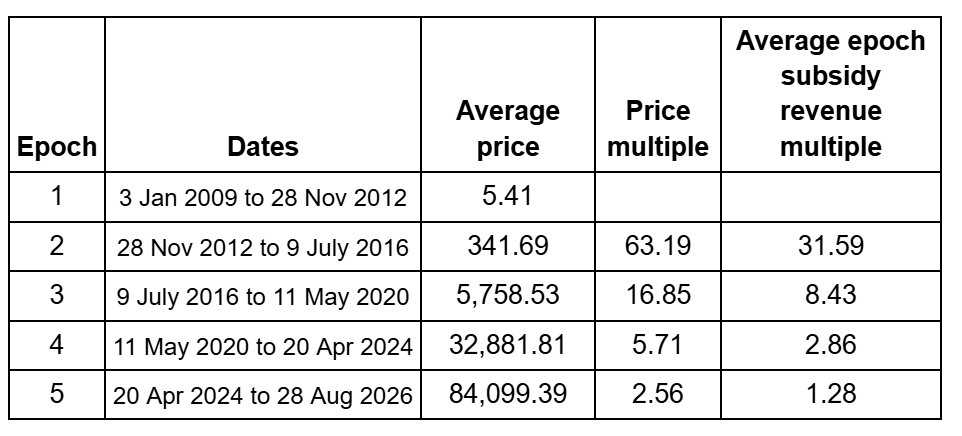
As can be seen from the table, the second epoch had more than 30 times the dollar subsidy revenue of the first epoch, and the third epoch had 8 times the subsidy of the second, while the fourth had 2.86 times the subsidy of the third. As expected, bitcoin’s difficulty, hashrate, and electricity consumption grew very rapidly during these periods, with the speed of the growth declining over time. The most interesting phenomenon here is that the fifth epoch, so far, has seen the mining subsidy increase by only 28% over the previous epoch.
The hypothesis can also be restated as: bitcoin mining will eventually stop growing when the subsidy multiple drops below 1+ the rate of dollar devaluation over four years. The table below shows the minimum subsidy multiple required to incentivize growing investment in bitcoin mining at each rate of dollar devaluation. The required BTC CAGR is calculated by compounding the dollar devaluation with the 18.92% annual hurdle rate over four years. And the required epoch subsidy multiple is half the resulting price multiple.

Based on investor estimates of annual dollar devaluation, the last column shows us what multiple of epoch subsidy is required to incentivize investment to grow bitcoin mining. By comparing the last two columns of the last two tables, we can see why bitcoin mining might not grow anymore. 28 months into this epoch, subsidies are only 28% larger than in the previous epoch, which means the subsidy is not beating dollar devaluation for anyone who estimates dollar devaluation at more than 7% per year, and it barely beats it at 6% devaluation.
Given this decline in mining rewards, it would be expected that bitcoin mining would slow down, or even contract. Unless there is a major turnaround in this metric, this trend may continue indefinitely.
Difficulty Decline
This pattern is also evident in the remarkable decline in difficulty over the past ten months. Bitcoin’s mining difficulty hit its all-time high on October 30, 2025, and 305 days later, it has yet to recover or exceed that level. This is the second-longest period of bitcoin difficulty failing to make a new all-time high. In the longest such episode, it took 363 days for the difficulty to make a new all-time high from August 1, 2011, to July 30, 2012. That decline came along with the largest price correction in Bitcoin history, when the price fell from $30 in June 2011 to $2 in November 2011, a staggering 94% drawdown. The third-longest period started on 16 May 2021 and lasted 252 days, until difficulty made a new ATH on Jan 23, 2022. That episode came in the aftermath of the Chinese ban on mining, a hugely significant development, since China at the time hosted the majority of bitcoin mining, forcing many miners to liquidate operations and sell or deploy their machines abroad. The need to liquidate operations also likely meant liquidating a percentage of their bitcoin holdings, causing a large crash in the bitcoin price.
What is remarkable about this current decline in difficulty is that it did not follow drastic developments like the first and third largest declines. The largest drawdown in bitcoin price from its October 2025 all-time high was only 54% so far, much less than the 95% of 2011; and no major regulatory development has affected bitcoin miners like in 2021. Yet difficulty has declined sharply, and if it takes more than 2 months to rise back, this will be the longest difficulty drawdown in bitcoin history.
Bitcoin Mining Reward Peak on 14 March 2024
Another remarkable fact is that two years and four months into this current fifth epoch of bitcoin, where the mining subsidy was 3.125 bitcoin per block, the dollar value of the daily mining subsidy has not exceeded the highest level set in the previous period, which was set on 14 March 2024, at a price of $73,800, with a block subsidy of 6.25 bitcoin per block. On that day, assuming 144 blocks were produced, the total mining subsidy was equal to $65m (144 blocks x $73,800 per bitcoin x 6.25 bitcoin per block). March 14 had the highest price in the previous epoch, and for the mining subsidy to match it in the current epoch, after the halving of the block subsidy, the price would need to reach $147,600. Since the price in this epoch peaked at $126,000, we are yet to see a day with a higher dollar block-subsidy value in this epoch. Should the price fail to hit $147,600 before the next halving, this will be the first epoch in which the daily mining reward does not exceed the high set in the previous epoch.
14 March 2024 may even go down in history as the day with the most valuable bitcoin subsidy, ever. With every forthcoming halving, the price will need an extra doubling before it can match the market value of the subsidy on that day. If the bitcoin price does not reach $147,600 in this fifth epoch before the next halving, it would need to reach $295,200 in the sixth epoch, between 2028 and 2032, to exceed the value on 14 March 2024, and it would need to reach $590,400 in the seventh epoch, between 2032 and 2036; and in the eighth epoch, it would need to reach $1,180,800. The required price will continue to double every four years. I am not asserting that any of these values are impossible, but I am saying that it is possible that they are not attained, in which case, 14 March 2024 will forever remain the most valuable day of bitcoin mining ever. More concretely, even if the value on 14 March 2024 is exceeded in any of these epochs, there must come another day whose mining subsidy value will never be exceeded, because bitcoin’s value cannot continue to double every four years forever. Once the entire world is using bitcoin as money, it is inconceivable that its market value will double every four years. If not 14 March 2024, some other future date will mark the peak of bitcoin mining.
Whether the peak of bitcoin mining has happened or not is a question which only time will settle, but the stronger point is that such a peak is inevitable at some point. At that point, bitcoin mining will have peaked in terms of capital invested and in terms of electricity consumed, but mining difficulty will recover and likely continue to increase as the efficiency of mining equipment improves.
Peak Electricity
The most direct test for this hypothesis comes from Cambridge’s estimates of Bitcoin’s electricity consumption. Preliminary data presented by the Cambridge Centre for Alternative Finance put annualized Bitcoin mining electricity demand at approximately 190 TWh in December 2025. Since then, the Cambridge Bitcoin Electricity Consumption Index has fallen sharply, with estimates during mid-2026 returning to roughly the high-130 TWh range.
This gives the hypothesis a clear empirical test. December 2025, at roughly 190 TWh annualized, may prove to have been Bitcoin’s peak electricity-consumption rate. If Cambridge’s comparable best-estimate series subsequently rises sustainably above that level, this particular claim will have been falsified. But the decline since December is consistent with the broader argument developed above: subsidy revenue growth is slowing, difficulty has remained below its previous high for an unusually long period, and the amount of electricity miners can profitably consume is beginning to contract.
The AI Accelerant
There is one more reason that suggests that we may have already witnessed the peak of bitcoin mining, and that is the emergence of AI as a major source of demand for data centers and electricity. As the number of data centers has exploded over the past four years to meet the exploding demand for AI, bitcoin miners have found an alternative lucrative source of revenue. Anecdotally, and from examining the activities of the major bitcoin miners, one can see a major shift in mining infrastructure toward AI data centers. This suggests that bitcoin mining has entered a new era, where it is no longer the only avenue for monetizing cheap and stranded energy, as AI can now compete for this, and with the enormous investment in AI, it may have hastened the decline in bitcoin mining capital expenditure and electricity consumption. Many of the stranded energy sources used for bitcoin mining are now more developed and better connected to the internet after years of bitcoin mining infrastructure investment, making them more suitable for AI data centers.
The key distinction between AI data centers and bitcoin mining is that bitcoin’s difficulty adjustment makes it a zero-sum game, whereas AI data centers are a positive-sum game. As AI increases users’ productivity, they can keep spending more on it, demanding ever-larger loads. But bitcoin mining competes for an ever-shrinking pie of bitcoin, dropping by half every four years. Difficulty adjustment further ensures only the most efficient miners profit, and margins keep getting tougher as more miners enter, and as the subsidy is halved without a corresponding doubling in revenue. But AI could result in enormous productivity increases across countless industries, and thus subsidize ever-growing demand. A bitcoin miner now faces declining expected returns from bitcoin halvings, along with potentially exponentially rising returns from AI productivity increases.
It is conceivable that AI may turn out to be a large bubble, and that much of this data center expenditure will be a waste. Chinese AI models seem to be able to achieve similar results to American models with a tiny fraction of the energy and processing power. In the unlikely event that much of AI expenditure turns out to be wasteful malinvestment, miners would return to bitcoin mining, but that would not change the fundamental analysis that bitcoin mining will peak at some point in the future.
Transaction fees
One factor left out of this analysis, to simplify it, is the growth of transaction fees, which have been a tiny part of miners’ income for most of bitcoin’s history. Should transaction fees rise significantly, then the following analysis may be invalidated, as mining rewards, which include the subsidy and the transaction fees, can rise to levels higher than the level of subsidies in the previous epoch. Yet bitcoin has grown enormously while fees have stayed flat or even gone down over time in bitcoin terms, and as second-layer solutions continue to develop, it may be the case that transaction fees will not rise significantly, and the total mining reward will never exceed the levels of the previous epoch. The idea that bitcoin transaction fees need to reach a particular “security budget” is largely misguided in my opinion. I do not believe transaction fees need to grow to any particular level in order to secure the network; the network is secured because of the possibility of paying transaction fees to route around mining censorship, not because transaction fees reach some particular level.
Implications
If this hypothesis is correct, this is not a problem for bitcoin. Bitcoin’s supply continues to grow according to schedule, and demand for it is likely to continue to increase as more people understand this, and understand that the supply of all other monetary assets increases at a much higher rate. We would enter a new era in which bitcoin grows while bitcoin mining declines in size.
The implication for bitcoin mining is that it is likely to become smaller over time, and possibly less profitable as well. This will likely cause more bitcoiners to shift their investments away from mining to just buying bitcoin, which is likely bullish for the price of bitcoin.
As bitcoin’s energy expenditure declines, the hysteria around bitcoin’s energy consumption is likely to wither away, along with much bad press. This is also bullish for bitcoin.
The actionable implication is: if you understand bitcoin’s value proposition, just buy bitcoin. If you have cheap electricity and the capacity for building mining facilities, pivot to AI data centers.
Conclusion:
Bitcoin mining used to possess a structural secular tailwind: monetization raised the purchasing power of each epoch’s subsidy much faster than halvings reduced its BTC quantity. That tailwind has collapsed. The current epoch’s nominal subsidy revenue is only 28% above the previous epoch despite a 2.56× increase in average BTC price; after accounting for dollar devaluation, the increase is already close to zero. Meanwhile difficulty is undergoing its second-longest historical failure to make a new ATH, Cambridge’s estimated electricity consumption has fallen sharply from a candidate late-2025 peak, and AI is raising the opportunity cost of premium mining infrastructure. Bitcoin’s fundamentals mean it will likely continue to grow, but bitcoin mining, and its electricity consumption, may have already peaked.
====
If you’d like to discuss this article with me, you can join Membership on saifedean.com, where we hold regular seminars on bitcoin, Austrian economics, current affairs, and more.
You can also listen to this article on The Bitcoin Standard Podcast: youtube.com/@saifedean
Note: To the best of my recollection, I first discussed this idea publicly in The Bitcoin Standard Podcast episode 200 with Pierre Rochard, starting at 1:04:16. The episode contains a longer discussion of why transaction fees do not need to reach a particular level in order to constitute a viable “security budget”.