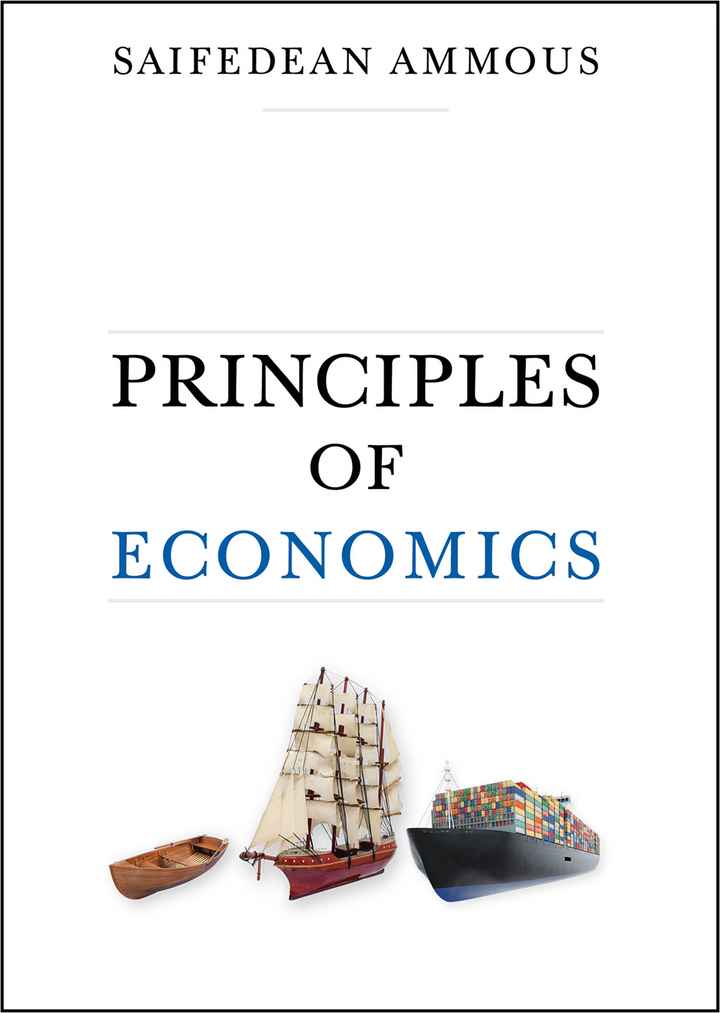
Lecture notes
Read the notes on this page or download the original PDF.
Download notes
YouTube loads when you choose to play. Watch on YouTube
This lecture explores economics as the study of human action and choice under scarcity, how humans act purposefully with deliberative reason, and why economic reasoning starts with understanding human action.
Read alongside the lecture and keep the source documents for reference.
Read the notes on this page or download the original PDF.
Download notesRead the accompanying book chapter.
Download chapterReview the slides used for this lesson.
Download slidesText from the original lecture notes. Download the PDF for its original formatting.
Principles of Economics


Lecture 1
Monday Sept 25. 2023


If you’ve found mainstream economics tedious and uninformative, you are not alone

Most intelligent people struggle to make sense of their economics university courses

The problem is not that economics is too difficult and sophisticated to understand, the
problem is university economics

===

University textbooks today are steeped in Keynesians’ high time preference and ignorance

It is impossible to teach anything useful with these textbooks as a base

These textbooks teach you some irrelevant models and thought exercises with little
relevance to the real world, and predictable conclusions

Austrian economics is a much more useful approach, which provides students with value

===

The Austrian tradition does not have an easily-accessible comprehensive textbook

Rothbard’s Man, Economy, and State, and Mises’ Human Action, are not easily readable by
the modern reader

More geared toward arguing with economists than explaining to readers

What we need is a simple explanation of economics from the Austrian perspective, aimed at
the learner, not the academic

===

This is the book I wanted to teach

This is the book I would have liked to learn at age 18

A clear, concise, and readable treatment of the main economic ideas in the Austrian
tradition, culminating in an understanding of the civilizational importance of the extended
monetary market order.
===

This book forms an introduction to the principles of economics, and the economic way of
thinking—a powerful tool of mental planning useful for everyone to understand.

It uses the plain written word to explain what many economists throughout history have
found to be the most powerful methods of understanding economic phenomena.

This online course is the equivalent of two university courses

===

   I.   Fundamentals
  II.   Economy
 III.   The Market Order
 IV.    Monetary Economics
  V.    Civilization

===

I. Fundamentals
Human action
Value
Time

==

II. Economy
Labor
Property
Capital
Technology
Energy and Power

==

III. The Market Order
Trade
Money
Markets
Capitalism

==

IV. Monetary Economics
Time Preference
Credit and Banking
Monetary Expansion

==

V. Civilization
Violence
Defense
Civilization


==


Chapter 1: Human Action

Mises’ Human Action offered an explicit redefinition of the field of economics as the study of
human action and choice under scarcity.

Mises: analyze human action, rather than analyzing material objects and their properties, or
aggregate and abstract units

==

Most intellectuals analyzed humanity as a whole or analyzed collectivist concepts like nation,
race, or church, and sought to find laws to explain the behavior of such entities and their
consequences, as if history had ironclad laws to be discovered, akin to the natural sciences.

Austrians focus on individual human choice and action

==

What is “Action”?

Purposeful behavior

“Action is will put into operation and transformed into an agency, is aiming at ends and goals,
is the ego’s meaningful response to stimuli and to the conditions of its environment, is a
person’s conscious adjustment to the state of the universe that determines his life.”

==

Rothbard: ““purposeful behavior toward the attainment of ends in some future period which
will involve the fulfillment of wants otherwise remaining unsatisfied.”

Humans act purposefully because we are endowed with reason and are able to direct it to
the meeting of our ends.

Animals yield to their instincts, but human reason supersedes it
Action is rational, in the sense of being the product of reason, not in the sense of being
correct

==

Economic Analysis

If economics studies human action, we can define economic terminology in relation to
human needs and how humans treat them

An economic theory consists of:
1- An understanding of the meaning of action
2- a situation described in terms of action categories
3- a logical deduction of the consequences

The goal is understanding

==

Logical deduction, thought experiments, and common sense familiarity with reality are
employed to understand the implications of economic processes.

Quantitative analysis is meaningless and mute without logical deduction and conclusions to
motivate it and understand its results

==

Quantitative Analysis

     1.   No constants
     2.   No replicable experimentation
     3.   Conflating factors that can be measured with the causal factors
     4.   Conflating accounting identities for causality

After a century of aping physics, economics has failed to produce one quantitative law or
formula that can be independently tested and replicated.

==

1. Economics has no constants

Without a constant, there can be no measurement, and therefore there can be no
quantitative relationships established

Since value is subjective, it cannot be measured

==
Appendix 1 compares quantitative approaches in natural science to economics

PV =nRT

P is pressure in bars
V is volume in liters
n is the number of moles (where each mole is 6.02214076 x 10e23 atoms)
T is temperature in kelvin
R is the Regnault constant of 0.083145 L.bar/mol.K.

This relationship is possible because all units are measured using constants defined by the
seven base units of the International System of Units (SI):

second, meter, kilogram, ampere, kelvin, mole, candela

==

These reliable physical units for measurement makes it possible to engage in systematic,
reproducible, and quantifiable scientific experimentation.

These constants and measurements make it possible to conduct systematic experimentation
with gasses at different volumes, temperatures, and degrees of pressure.

The reliability of these units is reflected in the number of workers and technicians who use
the same tools and equipment with commonly agreed-upon standards.

==

There are no equivalent constants in economics

Economic value can only be measured ordinally, in a way that compares the value of one
good to another, and not cardinally, by assigning a mathematical value to each good.

Value is experienced psychologically, it is not physically defined

So quantitative analysis of economics breaks down.

==

2. No replicable experimentation

In natural science, you study physical objects, and you can perform experiments on them to
establish relationships

In economics, we study the action of humans in the real world. Laboratories cannot
approximate that
==

3. Focusing on what can be measured, not what matters

The driving force is individual action and subjective valuation, but that can’t be measured

Economic aggregates can be measured, so we focus on that

==

4. Mistaking accounting identities for causality

Macroeconomics assumes relationships based on accounting identities must mean causality


==

After a century of aping physics, economics has failed to produce one quantitative law or
formula that can be independently tested and replicated.

The poster-child for quantitative economics’ failure is the mythical trade-off between
unemployment and inflation

==

According to modern economic pseudoscience, based largely on the work of English child
rapist John Maynard Keynes, there is a trade-off between unemployment and inflation

But reality stubbornly refuses to abide by this fiction
==

No studies or experiments are possible, but Keynesians nonetheless assume they can
establish this as an economic law.

And when reality fails to conform, they simply redefine terminology to try to keep their theory
alive. This is the quintessential pseudoscientific method.

==

A contrast of approaches

How does the approach of mainstream quantitative economics differ from that of Austrian
praxeological economics?

Take minimum wage as an example

==

Mainstream quantitative economist has a quantitative model:

20% of all workers, supporting 35% of all the population, currently earn less than $10 per
hour.

$10 minimum wage would lead to a rise in wages equal to $10 billion per year

This results in $8 billion increase in spending
Creates 40,000 new jobs, 12% increase in industrial output, $16 billion increase in GDP

==

Austrian economist analyzes things through human action

Two people need to agree to create a job: Worker and employer

Employer will only employ the worker if return from employment exceeds wage

If worker has a lower productivity than the mandated minimum wage, the employer will not
hire the worker

Minimum wage law makes it illegal for employers to hire anyone whose marginal productivity
is less than $10 per hour

==

Minimum wage law criminalizes employment fo the youngest, poorest, and least
experienced, making it very difficult for them to gain experience and break out of poverty

Businesses would raise prices or lower quality

Businesses could increase automation

==
Empirical observation concurs far more with human action analysis than with quantitative
approaches

See: Forty Centuries of Wage and Price Controls

==

Collectivists look at the world of economic transactions as an inhuman process they can
alter to suit their needs.

They mandate that the observable epiphenomena associated with markets fall within
acceptable ranges. They assume humans will just adjust their actions to ensure these laws
are upheld.

In reality, humans adjust their actions to optimize for their own well-being, not to satisfy
bureaucrats.

The merchant would rather not sell at all than sell at a loss. You will either see the
free-market price or you will see no market price at all.

In the latter economy, real prices are expressed in underground markets.
==

Almost all modern economics textbook approach economics from the pseudoscientific
quantitative approach

This course and book will be differentAvailable in hardcover, ebook and audiobook.